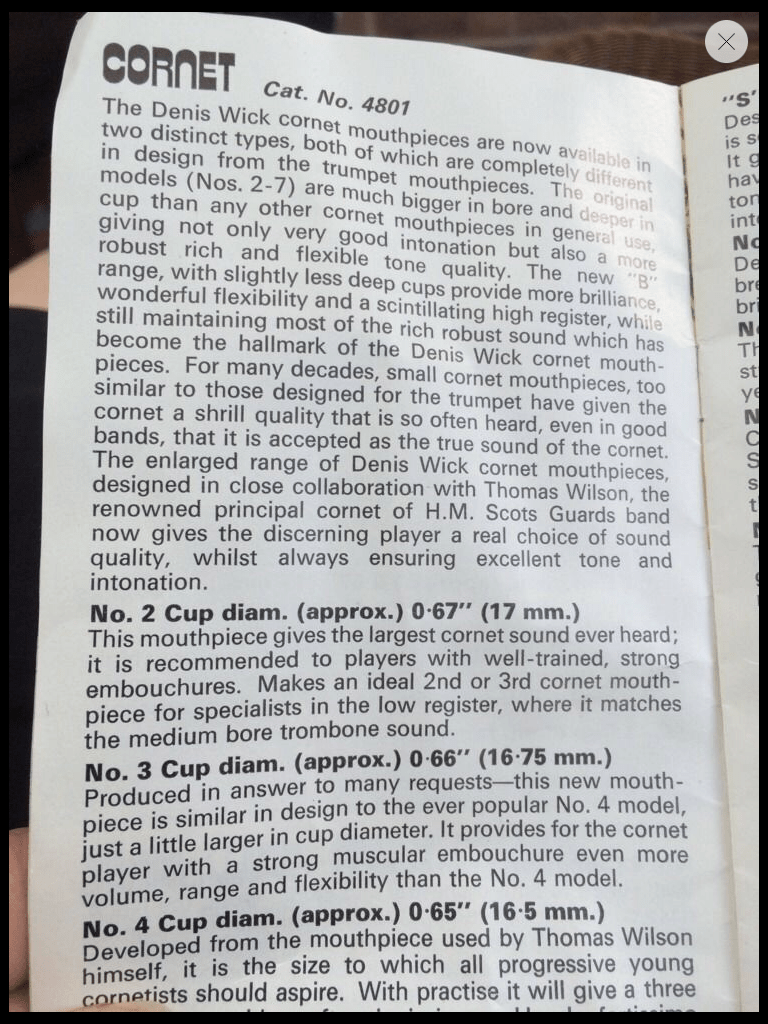
According to this 1970’s Denis Wick leaflet the cornet mouthpieces were designed in association with Thomas Wilson, principal cornet player with the Scots Guards:
Here is a web page which tells you all about Tommy Wilson, who emigrated to Canada and also performed as a soloist with the Salvation Army:
http://londoncitadelband.on.ca/tommy_wilson_bio.htm [2026 update: dead link]
In the early 1970’s I was asked by Denis Wick if I would help him develop a cornet mouthpiece – and the rest, as they say, is history. It was also round about this time I was asked by Boosey & Hawkes if I would help in the development of a new cornet for them. After a lot of hard work the first large bore Sovereign cornet was born. I still play the original prototype. It’s still going strong after over 30 years. It was stamped No. 1, (which causes the customs people more than a little curiosity when London Citadel Band goes on trips).
Sizes and Development
Originally there were sizes 2, 4, 5 and 7. Size 3 was later developed by scaling up a size 4. The rim of the Size 4 was based on an Austrian rotary trumpet mouthpiece belonging to Elgar Howarth, that had already been used for a Wick trumpet mouthpiece. Size 2 seems to be based on an older Bach 1.5C rim, being a very popular orchestral size mouthpiece. Size 7 was designed for players who were used to the older smaller sizes of mouthpiece like KosiKups but was discontinued in the 1980s. A 4 1/2 model was added later which was the same as a 4 but with a smaller throat.
B & C Cup models
B cup mouthpieces were added later. These have more of a U shaped cup and tighter backbores. C cup models with longwer shanks were introduced for use in orchestral and symphonic wind bands but had been discontinued by the mid 1980s.
Controversial opinion
When Denis Wick said that he had introduced mouthpieces of a depth that had not been seen for a generation I think he was a bit misled. Having handled countless 19th and early 20th century cornet mouthpieces none are as deep as Denis Wick no letter mouthpieces. Apart from some mid 19th century Cornopean mouthpieces that were designed for accompanying singers or for use by French Horn players, who were some of the first to take up the Cornopean or Cornet-a-Pistons. I assume he had seen some of those and made the assumption that they were the norm.
The vast majority of pre 1930 cornet mouthpieces have small diameters and more moderate funnel shaped cups with tighter throats than any of the Wick line up.
What Denis Wick did do was to change the sound of a brass band cornet section. Along with increasing bore sizes, the Wick mouthpieces helped to give cornet sections a much greater dynamic range.
 Hudson.nu