This is the summary of my research into Douglas & Son, brass musical instrument makers of Glasgow.
My interest in Douglas and Son started when I acquired a cornet with the company name engraved on it several years ago. I had never seen an instrument with a Scottish maker’s mark so I had it restored to a playable condition. The bell is engraved Douglas & Son Ltd, 66 Brunswick St, Glasgow. It is a high pitch cornet that has been converted to low pitch at some point. I originally thought it was made in the 1880’s but my research into the company name show it is probably post 1908 although the style is earlier. Here are some photographs from before and after the rebuild:
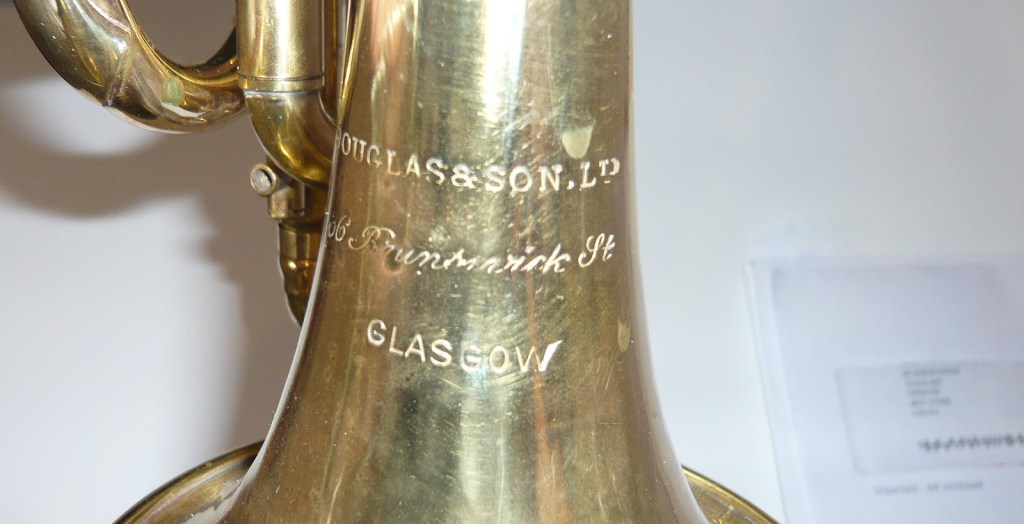
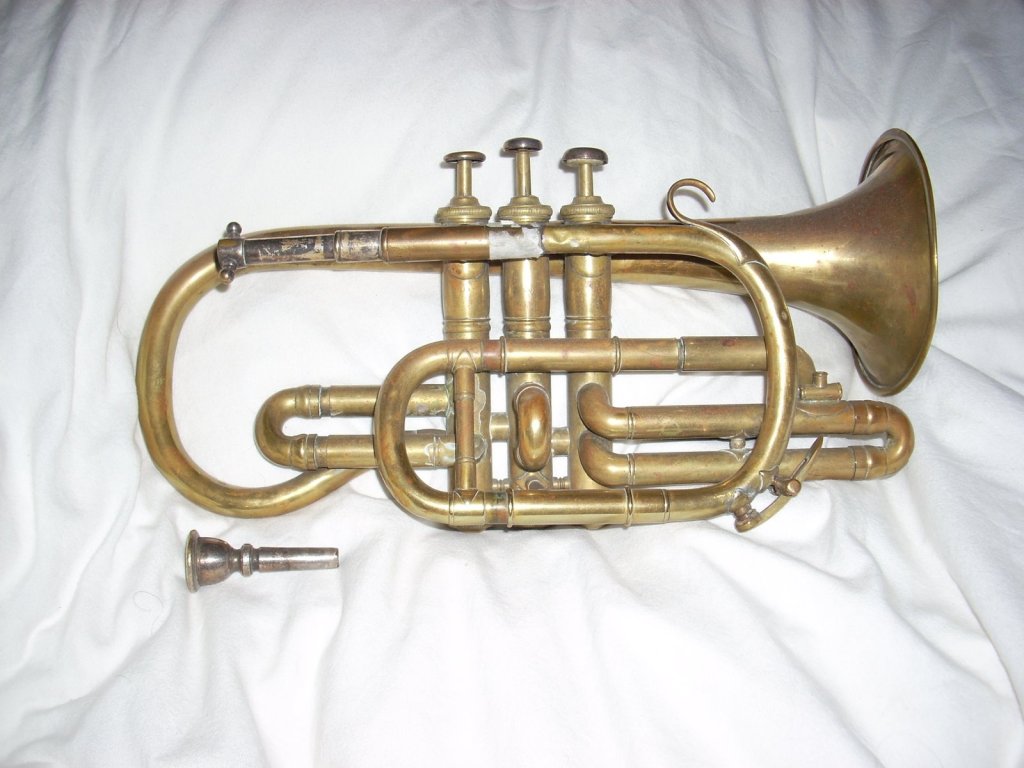
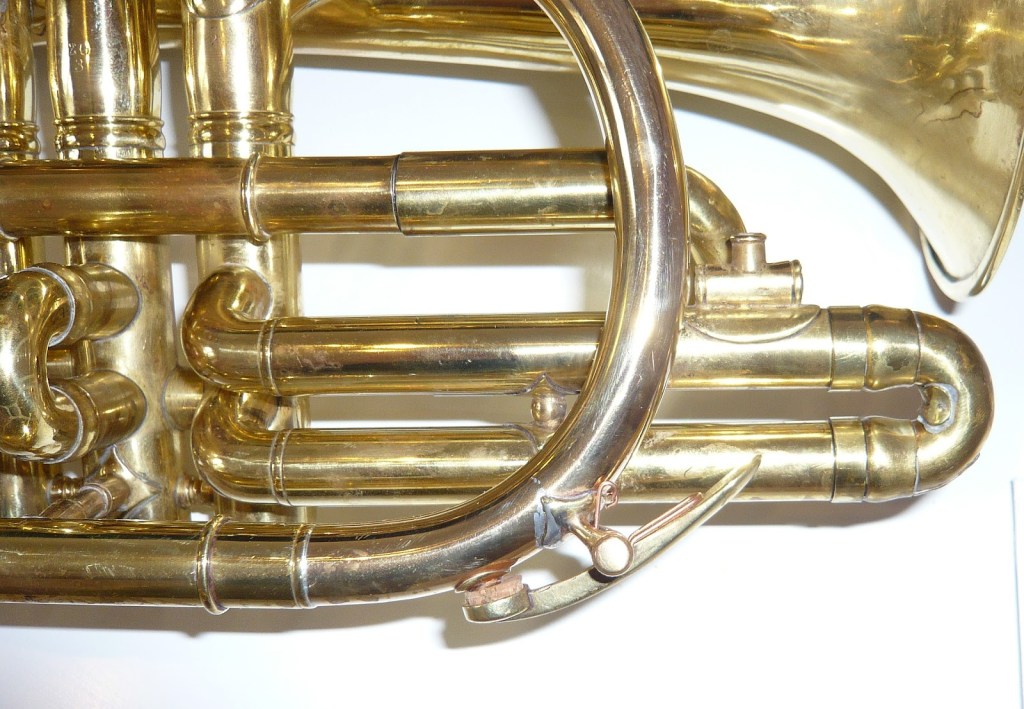
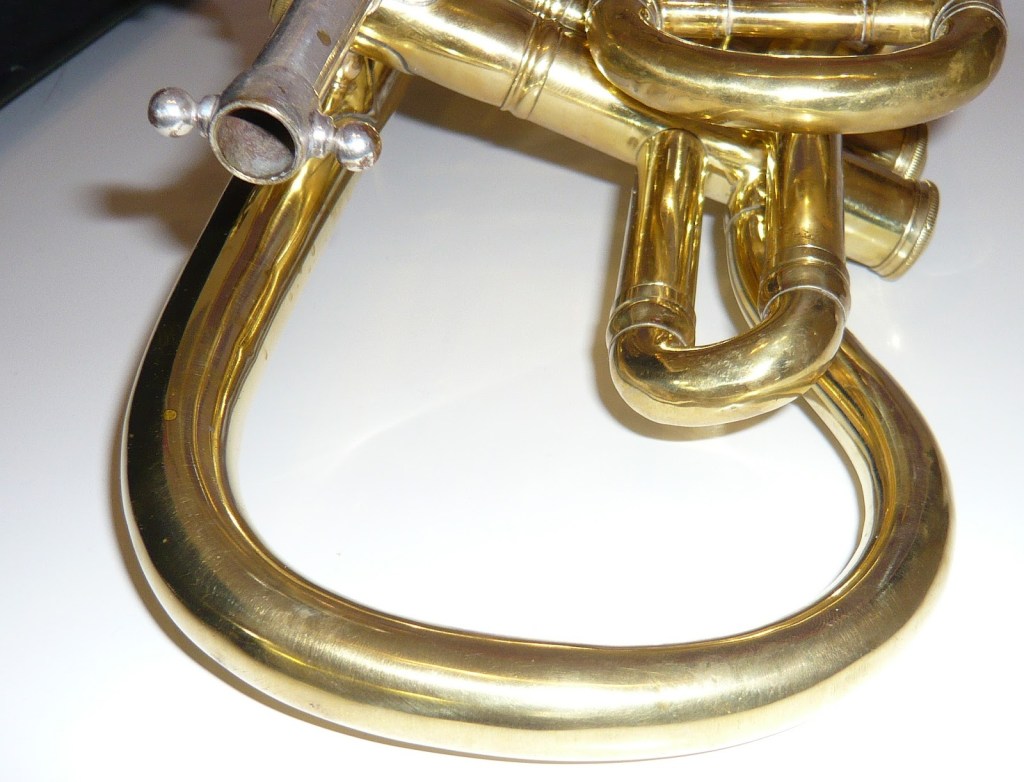
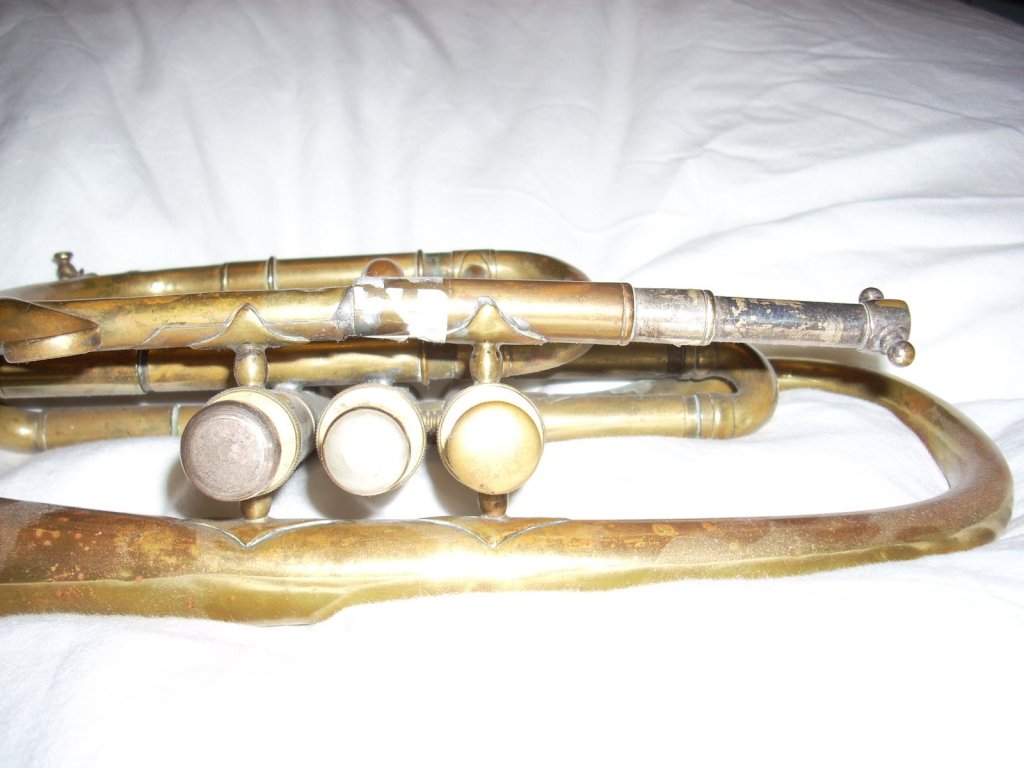
Having done considerable research and looked at lots of instruments its clear that this instrument was made by Jérôme Thibouville-Lamy & Cie of Paris. You will see later in this article that Douglas had a relationship with them and owed money to them at the time of his death.
There is a similar cornet in the collection of Edinburgh University marked “Douglas and Son” which they date to “1860 probably c 1872”. This company name does not match any of the ones I am able to date, but my hunch is that their instrument is closer to 1907 as the earlier ones reference Hugh or H D Douglas. Mine must be post 1907 as it has Ltd in the company name, but is built in the earlier style.
Kelvingrove Art Gallery and Museum in Glasgow used to have a Douglas cornet listed in their collection, but it is not currently showing up in their online archive.
The story of Douglas and Son
Hugh Dow Douglas was a musical instrument maker who started his business around 1850 at 190 Trongate, Glasgow. His company made or sold a variety of woodwind, brass and bagpipe instruments aimed at the military and growing civilian wind band market.
Douglas himself was a brass player and is listed as Bugle Major of the 1st Lanarkshire Rifle Volunteers. The 1st Lanark had a bugle band, but by 1887 it had become a brass band under Mr Robert Strachan and promoted to the 1st Battalion, replacing the pipe band who were demoted to the 2nd. The 3rd Lanark didn’t have a band. They had a football team instead, which went on to become quite famous. Its probable that Hugh Douglas started in the bugle band and moved into the brass band, possibly even supplying some of the instruments.
Douglas seems to have been something of an entrepreneur and saw the potential for the new brass instruments to supplant woodwind instruments in civilian bands as a money making opportunity. In 1862 he organised and sponsored the first brass band contest in Scotland (known as H D Douglas’ Contest) with a series of further competitions in 1864 and 1865. The top prize was £77 – equivalent to £1600 in today’s money.
Credit is due to the late Mr. H. D. Douglas, musical instrument-maker, Glasgow, who was Field Bugler to the 1st L.R.V., for having attempted to do something for the improvement of these bands while they were still brass bands. He organised contests in 1862,1864, and 1865, with the view of “increasing the efficiency of the Volunteer and other bands in Scotland.
(Music for the people: a retrospect of the Glasgow international exhibition, 1888, with an account of the rise of choral societies in Scotland, Robert A. Marr 1889 (reprinted in The British bandsman: the official organ of the National Brass Band Championships, Volume 1, Issue 24 quoted in this article).
However, later in 1862 something appears to have gone wrong and he was in debt with his assets subject to sequestration (notice from the Edinburgh Gazette):
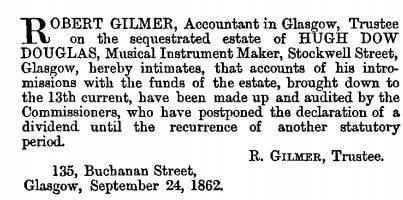
Maybe he was one of the first promoters of brass band contests to find out that there was no real money in it?
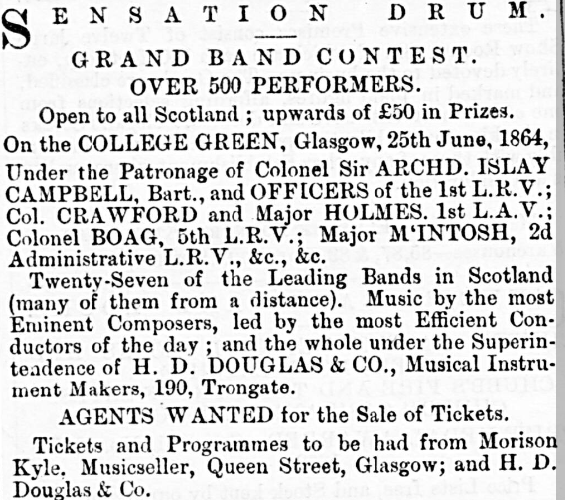
Notice of a band contest in Glasgow Green on 25th June 1864, sponsored by H D Douglas & Co with £50 of prizes (Glasgow Courier 25th May 1864):
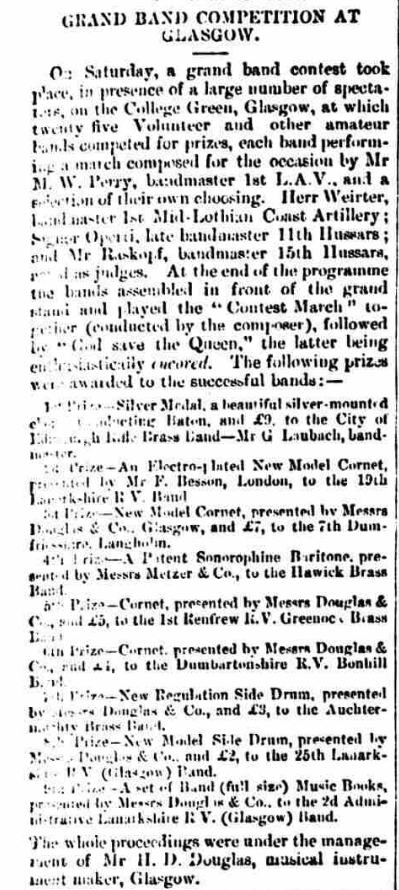
Report of the prize winners in the 1864 contest (Southern Reporter 30th June 1864). It is not very easy to read, but there were a number of cornets presented as prizes. These contests were a mix of military wind bands and and the new style civilian brass bands. first prize winner was City of Edinburgh Brass Band:
A possible picture of HD Douglas?
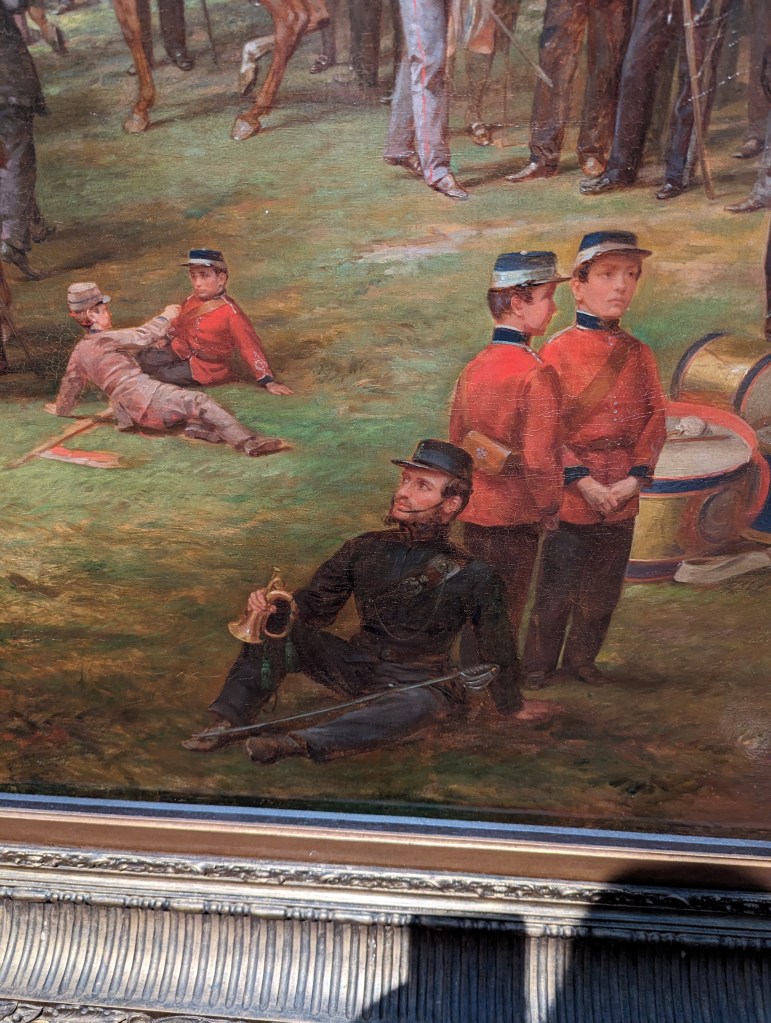
From “the Glasgow Volunteers 1864-66” by Thomas Robertson.
This painting on display in Kelvingrove Art Gallery and Museum shows the various Glasgow volunteer rifle brigades with a prominent bugler who may be Hugh D Douglas. He is portrayed with a C bugle with a Bb pigtail attachment. This detail makes it more likely it is a depiction of a real, rather than imaginary character. Very few regiments used a C bugle. Most owners of a C bugle were using them with a valve section that fitted onto it and converted it to a Bb cornet.
Business Names and locations
In spite of previous financial troubles his business continued and by 1870 included his son at expanded premises 36-38 and later incorporating no 42 Brunswick Street. Then in 1908 the firm moved to 66 Brunswick Street.
1850 – 1870 Hugh Douglas, 190 Trongate
1870 – 1907 Hugh D Douglas & Son, 36-42 Brunswick Street (their first retail shop selling instruments)
1907 – 1920 Douglas & Son Ltd, 66 Brunswick Street
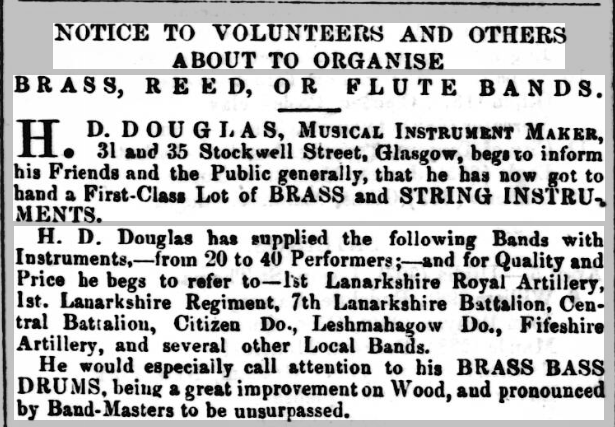
Advertisement listing some of the territorial army bands he had provided instruments for and extolling the virtues of his new drums (Greenock Telegraph 13th April 1861):
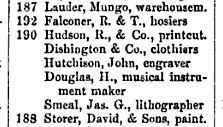
Entry for H Douglas 190 Trongate, Musical instrument maker in the 1866 Glasgow Post Office Directory:
Entry for Hugh Douglas in the 1866-1867 Post Office Glasgow Directory – note his home address is listed as 25 Main Street, Gorbals:

His display advertisement fromn the 1870 Glasgow post office directory:
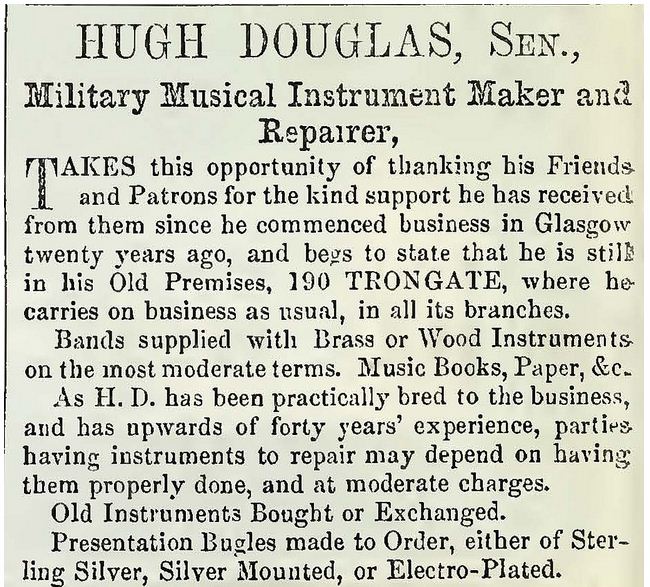
Announcement that they have opened a retail shop rather than just being repairers. (Ardrossan and Saltcoats Herald 11th March 1871):
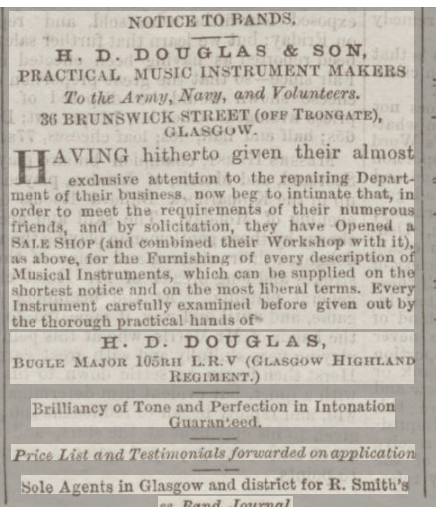
His display advertisement from the 1875 Glasgow post office directory:
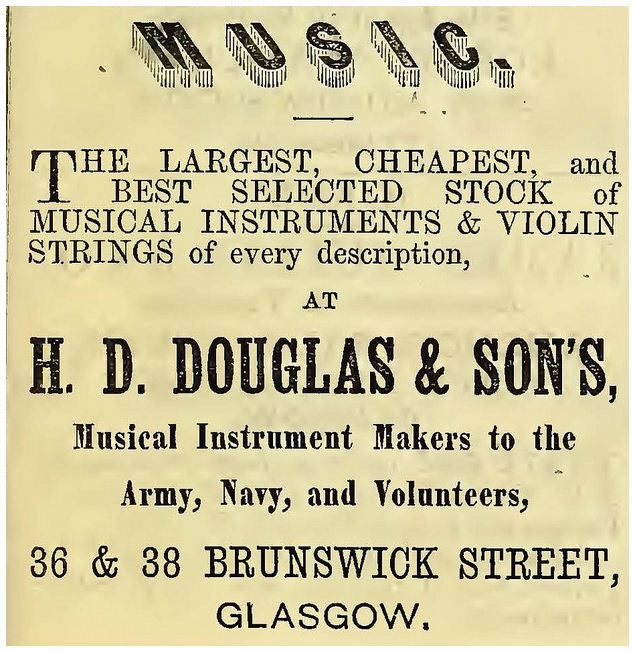
Display advertisement from the 1893 Glasgow Post Office Directory (Hugh D had died in 1887 and the business was now run by his son):
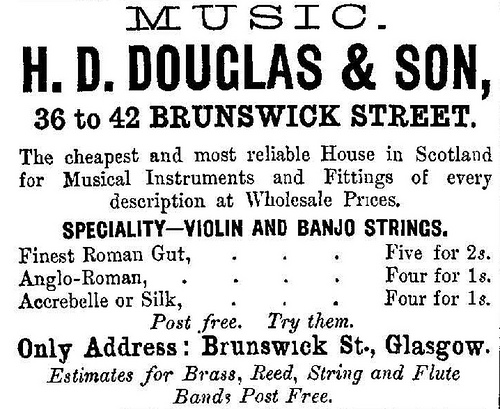
Display advertisement from the 1900 Glasgow Post Office Directory:
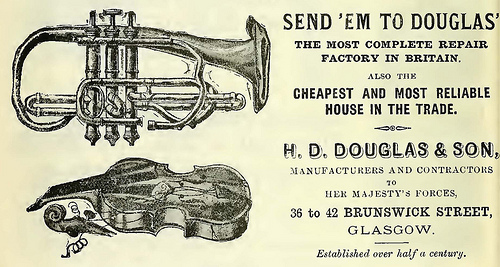
Douglas & Son Limited
The company Douglas & Son Ltd (company number 6545) Was formed in 1907 (source – National Archives of Scotland).
66 Brunswick Street
Brunswick Street in 1913, photographed by the Springburn photographer William Graham. No 66 is on the right hand side at the end of the row:
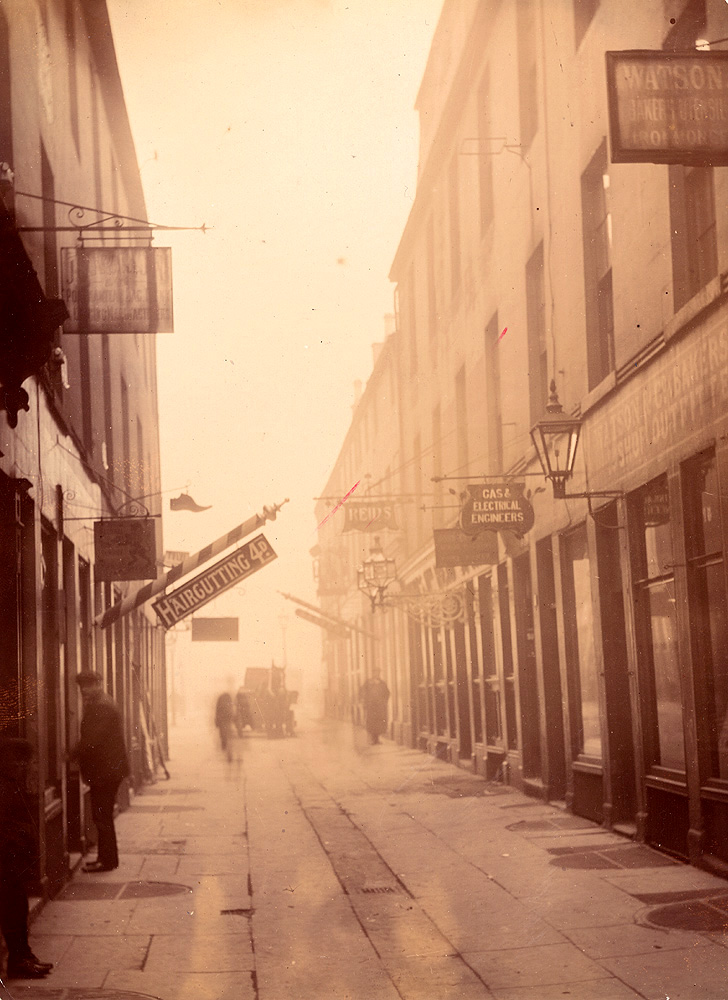
A shop sign carrying a representation of a bugle and other musical instruments is just visible in the distance:
By the onset of the first world war the company was producing bagpipes.
Manufacturer?
Its not clear if Douglas & Son made brass instruments themselves or just marketed other peoples. His premises were rather small and although that does not preclude manufacturing of small instruments, manufacturing the full range of larger instruments he sold would have been difficult. At the time of Hugh D Douglas’ death in 1887 he was selling instruments made by Thibouville Lamy of France (according to his will which lists a debt to that company), but he also owed a debt to an electro plating company in Glasgow so he must have been repairing or manufacturing something.
The end of the business
When Mrs Douglas died in 1899 the business was put up for sale. His son, John, had died in 1890 and Mrs Douglas had run the business until her death.
Public notice for the same of the business (Glasgow Herald, 21st July 1899):
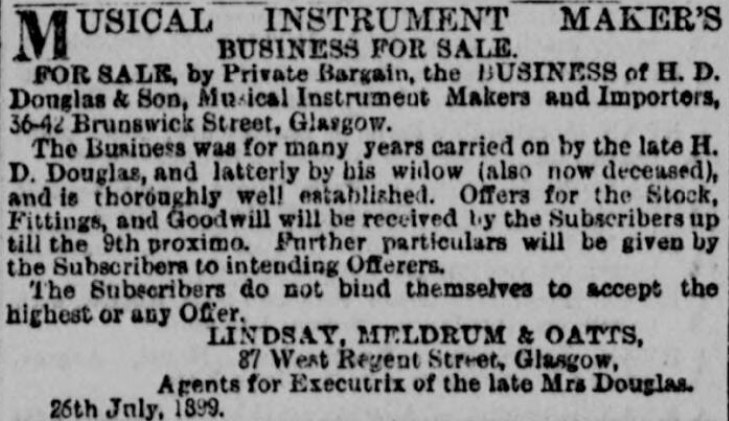
The business was bought by his former apprentice and employee John McInnes. Sadly, he died after falling from a bus on his way home from running a trade stand at the Scottish Brass Band Championships in Hamilton in 1931 (Daily Record 26th October 1931):
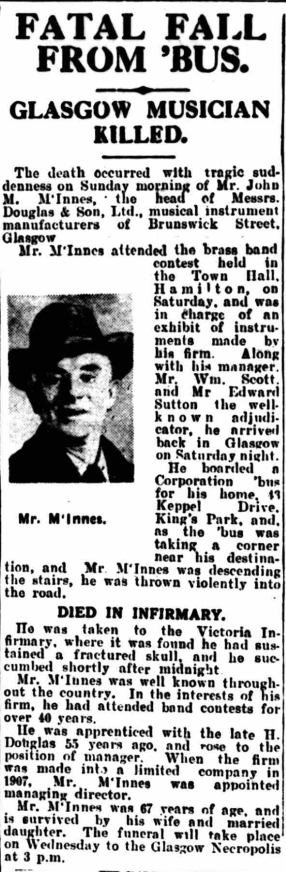
I don’t know what happened to the company after this point, but I am continuing my research.
Appendix: Genealogy of Hugh Dow Douglas
I undertook this work to try and determine who the son was in Douglas and Son which resulted in a bit of a family tree appearing.
Hugh died in 1887 and many of his children died in infancy. He had two surviving sons:
- John Gray Douglas, 03 Jan 1867, Glasgow, died 1890
- Hugh Dow Douglas, 24 May 1869, Glasgow, died 1865
Both were too young to have inherited the business on their father’s death, but the business was continued on by his wife until her death in 1899. John Gray Douglas is listed in the 1881 census as a “music seller” so it seems that he is likely to be the “& Son”.
Birth:
Hugh Dow Douglas 04 Jul 1833, Perth – parish register entry
Parents:
Hugh Douglas (occupation also given as a musical instrument maker on Hugh D’s death certificate of 1887)
Margaret Walker
Marriage:
Christina Gray (died 1899).
Residences:
1866 post office directory – 25 Main Street, Gorbals
1871 census – 37 North Albion Street
With his wife Christina, son John (aged 11) and Christina Milne (a saleswoman)
Occupation – assistant instrument maker employing one boy
1881 census – 106 Sauchiehall Street
With Christina and son John G
Occupation – music seller
Death:
04 April 1887, Glasgow (106 Sauchiehall Street), from liver disease – death register entry
According to his will lodged in the Glasgow Sheriff Court Hugh D Douglas died with debts including:
- £4 to Thomas Smith and Son Electroplaters
- £86 to J Wallis and Son, London (suppliers of woodwind instruments)
- £35 to Thibouville Lamy & Co, London (manufacturers of brass instruments)
- £3 to Riviere and Hawkes of London (later an instrument maker, but at this stage making instrument reeds and publishing music for military bands)
His main asset on death was his shop stock, worth £689. His cash in hand was insufficient to pay for the funeral. The business was inherited by his wife along with the rest of his estate.
Children:
Christina Douglas, 25 Jul 1859, Glasgow (died in infancy)
Margaret Douglas, 13 Jun 1860, Glasgow (died in childhood)
Christina Gray Douglas, 24 Nov 1861, Glasgow (died in infancy)
Christina Douglas, 07 Nov 1863, Glasgow
Hugh Dow Douglas, b 18 Aug 1865, Glasgow (died in infancy)
John Gray Douglas, 03 Jan 1867, Glasgow (the & son – died 1890)
Hugh Dow Douglas, 24 May 1869, Glasgow
Margaret Walker Douglas, 30 Jul 1870, Glasgow
 Hudson.nu