(This article was originally written in April 2014 and is republished here from my previous blog. You will find a completely new section at the end of the original article which was written in march 2026).
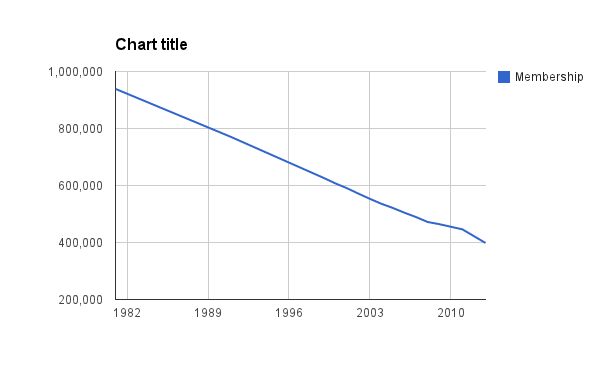
According to this article Church of Scotland membership has declined by at least 50,000 over the past three years (approx 17,000 per year).
As the number of communicant members of the church is 446,179 a linear projection would show the Church of Scotland running out of members in 26 years (2040).
This is actually better than many of my colleagues predicted when we graduated in 1993. Most felt that the kirk would see them out to a pension. As they were mainly in their late 20’s and would be expecting to retire at 65, that would have been around 2030.
The Church of Scotland itself predicted this:
“In 1980 a report to the Kirk’s Council of Ministry predicted the reduction in membership – and in 1997 the church suggested that if the decline in numbers continued, it would cease to exist by 2033.” (BBC)
Of course, a linear decline is not realistic. There will always be some members left, and a rump of the kirk will always remain. The real question is not the decline of the Church of Scotland, but how other churches take up the challenge to fill the gap left by it.
The historical decline in membership since 1981 looks like this (figures were originally in a table here but they have vanished from the BBC web site):
2026 Update
At the time I wrote the original article, above, I was working for a church organisation and its fair to say that it was not received well. All hell broke loose after a journalist decided to mention it in an article.
It might seem odd that people got so angry, but back then there were not the extensive church closures or reorganisation that we see now in the Church of Scotland. It was very much heads in sands, especially amongst ministers of my age group who just wanted to retire before the trouble started. Pointing at the elephant in the room was not welcomed.
Life became very difficult for a while, but in the end it came to nothing and all the trouble just made me even more interested in the subject.
So, silently, over the past 12 years I have tracked a range of stats:
- Total membership
- Percentage reduction over past 12 months
- Number of congregations
- Number of new members (by profession of faith)
It was not a heavy task. I have an entry in my diary once a year to find the figures and add them to my spreadsheet. Some years the statistics were difficult to get as they were handed on paper to general assembly commissioners rather than being published, but I had my sources!
From the raw statistics this I was able to make graphs and do deeper analysis. Over the years its become clear that I got some things right and some things wrong. My basic theory that it would be a straight line rapid decline has been proved correct, but the rate of decline has been much faster than I predicted.
Current Church of Scotland membership decline graph
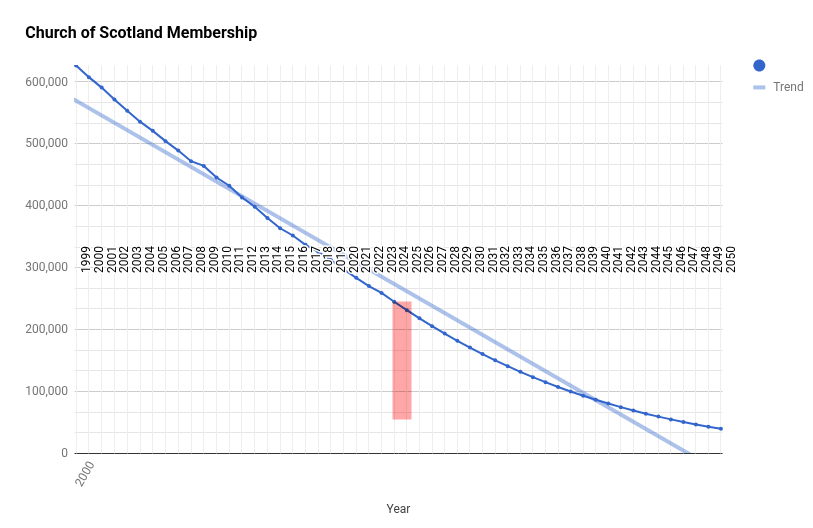
The red line is where we currently are. Everything to the left of it is actual figures. Everything after the red line is predicted figures. Membership has continued down in a straight line and not flattened out yet, but now it looks like it will hit 100,000 in 2035 rather than 2040 and be flattening out around 39,674 in 2050.
By 2015 it was clear that the percentage reduction of members was not static, but increasing each year:
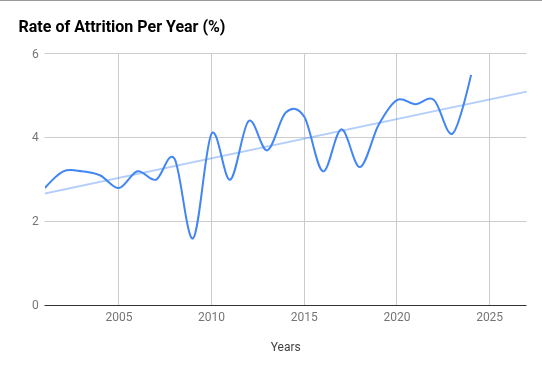
The membership prediction figures in the larger graph are based on projecting that attrition rate forward and assuming no significant recruitment. This prediction model has been very accurate so far. Within a couple of percent of the actual membership figure every year.
Reasons why membership is declining:
- Fewer than one new member recruited per congregation per year e.g. in 2024 there were 695 new members across 992 congregations. The previous year it had been 776 over 1136. If you analyse that recruitment by presbytery and congregation a lot of it is down to a small number of larger congregations, especially close to universities. Most congregations get no new members at all.
- Age: half the current members will be dead by 2040.
- The Church of Scotland effectively stopped doing mission in the 1980s. That’s why there are fewer people in their 40s and 50s than in other Scottish denominations.
Conclusion
I believe this article is a reasonable commentary on publicly available information and I am continuing to monitor the statistics each year.
 Hudson.nu