The Challenge
At the beginning of 2023 I challenged myself to try and work 100 countries on HF by the end of the year in spite of my antenna restrictions. By December 31st I had managed to work 102 countries. I achieved this with indoor antennas and 10-50w of power. I hope this article gives some encouragement to people with antenna restrictions.
Background
A few years ago I moved into a bungalow which is cut into the bottom of a hill. This means that a wire from the chimney to the back garden would be quite low to the ground unless I had quite a substantial antenna support.. The logical solution is a vertical but we spent the whole Covid period trying to get an extension built so I could not run feeders across the garden. That temporary difficulty forced me to experiment with antennas in the loft space, and it is those antennas that enabled me to communicate with 102 countries.
Experimentation
The house has a pyramidal roof with a peak about 4.5m above ground level at the front of the house and 3.5m at the back (due to it being cut into the hillside.

The elements extend downwards into the right side of the loft space.
I ran a length of good quality (Webro branded) RG58 from a ceiling hole above the operating position to the highest point of the loft. From here I added a dipole centre and bent a 20m dipole around the loft. After a while I added a 15m dipole element to make it a fan dipole. I made the elements from surplus 30 amp 12v red and black cable, some spare coax cable and some 32/0.2 multistranded wire. The ends of the elements on the lower bands end about a meter above the house gutters.
This aerial worked to some extent but there were two drawbacks:
- Receive noise level of S7-9
- Poor DX performance as it was too close to the ground.

Reducing my receive noise level
I decided to work through the RF noise problem first. I used a Medium Wave radio tuned to around 600 KHz to track down all the items in the house that were emitting an RF buzz. Most of this was plug-in power supplies and chargers. I removed all phone chargers and replaced them with larger capacity, multiple output, ones. I can’t recommend any particular brand of charger as the designs seem to change all the time. I bought four and found two were quite noisy and two quite quiet.
I added clip on ferrite cores to all leads coming out of the chargers. I then went round every electrical appliance like TVs and the broadband router and added ferrites to every signal and DC power lead going in and out of them. This reduced my noise level to S5-7. The other big source of noise was Phillips 12v LED lights in the Kitchen. I have never fully resolved this, so I just keep them switched off when I am operating.
I then read G3SEK’s article about cleaning up your shack. I built his filter, but I have to say it didn’t make the massive difference I was expecting. It did change the characteristics of the noise (it was less buzzy) but the strength was much the same. I concluded, based on G3SEK’s article that the interference must be getting picked up on the outer of the coax so I added a 1:1 balun at the feedpoint and a line isolator at the radio end. This was made from 15 ferrite beads that are as tight fit on RG58 coaxial cable, covered in heatshrink and used as a patch lead.

My receive noise reduced to S1-3. It’s S3 on 14 and 17 MHz, but S1 on bands above, and below, that. Previously I could barely hear anything on 10MHz as the noise was S9. This morning I worked the US on that band with 10w!
Improving DX performance
I realised with the feedpoint being so low that I would need to concentrate on the higher bands, where it might be high enough up for the the inverted V configuration to have a lower angle of radiation.
I changed the elements to dipoles for 17m, 12m and 10m because most of my operating is done at weekends and I wanted to avoid contests on the WARC bands.
This was not entirely successful. The 10m element would not tune. I initially thought it was because the 12m one was too close in frequency, but it seems to have been a problem with the balun or the length of the coaxial cable.I decided that the best option was to extend the 10m element for 20m, but use loading coils so it didn’t have to drop down to the bottom of the eves or bend it around the loft space.
I had somehow avoided making loading coils for the past 40+ years on the air so I had to read up on the best options for loading a dipole and got some help from online calculators.
Loaded dipole calculator:
https://www.66pacific.com/calculators/coil-shortened-dipole-antenna-calculator.aspx
Inductance calculator:
https://www.66pacific.com/calculators/coil-inductance-calculator.aspx
I made the two loading coils on kitchen roll tubes because I had them in the recycling bin and indoor antennas don’t need to be waterproof. I calculated the antenna length to have 30cm of wire before and after the coils so I could trim the ends to get the antenna resonant.
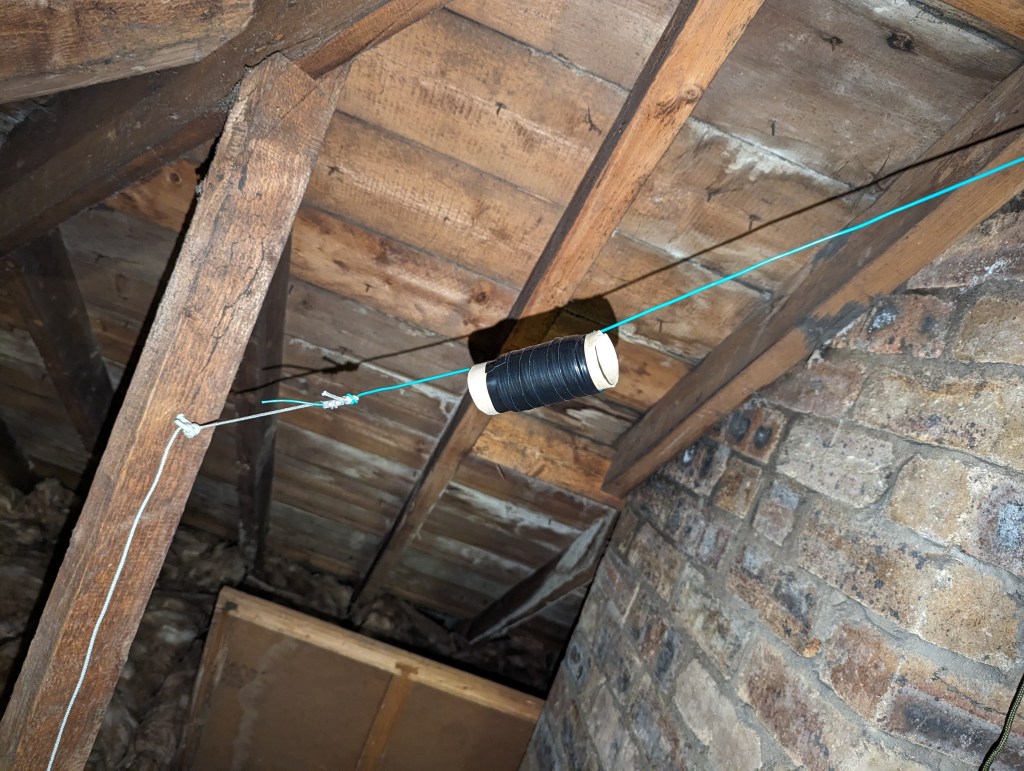
The brickwork is the chimney seen in the previous photo.
The completed antenna has elements for 12m, 17m and 20m and is very efficient. It gives me the whole of 17m and 12m without a tuner and 150 KHz. on 20m, indicates that my loading coils are high-q enough to not be seriously lossy.

I am able to use it on other bands using an ATU. On 10m the VSWR is 2:1 at the bottom of the band, and on 15m its 3:1 and I match these using a mAT-30 auto tuner. Unfortunately, due to balun or feeder issue, the performance on 10m is still not great, but it gets me some contacts. Including one CW contact with a VK6 at a time when I could hear no other signals on the band. I also use the ATU on 30m and this has been much more successful with a number of of transatlantic contacts. I think there is a more level playing field on the lower bands as fewer people can put up an antenna with gain. I even managed an SSB contact with Ireland on 40m with it.
Operating Strategy
Early in the year I realised that with little free time to sit in front of a radio I would need a strategy to get to 100 countries. I decided that trying to break pileups would probably be a lost cause, but contests would be a safe bet for increasing the number of countries worked.
I started off with general operating on CW which quickly got me to 20 countries. Each week I looked at the contest calendar to see what was coming up. Unfortunately I found conditions during the CW and SSB CQWW to be quite poor, but CQ WPX added around 20 countriesto my total. Operating on 15m (and some of 20m) required the use of an ATU in these contests.
I also started monitoring greyline times using the map at www.pskreporter.info. This shows the current location of the solar terminator. I will often monitor this and live solar information in the evening. If it looks like a good opportunity then I will get on and see if I can work anything new. One thing I haven’t done is use the DX cluster as I am not chasing dxpeditions and I find that a lot of the spots are US stations spotting Europeans which isn’t that helpful.
Results
During the first half of 2023 I was still getting the aerial working correctly, but I managed to work 102 countries using 10-50w output. About a third of this was on CW, a third on SSB and a third on FT8/4. I started experimenting with FT8 two thirds of the way through the year. 50% of contacts have been 10w.
I get the best DX on 12m, when the band is open, because the aerial feed point is closer to a half wave above the ground on that band. On the other bands its a lot less than a half wave, but I still get a lot of North American contacts on 17m.
The one that got away was Guernsey. Hardly a day goes by without me hearing stations in Jersey or people working stations in Jersey, but I have not seen any sign of Guernsey during 2023. It is the only European DXCC entity I didn’t work during 2023 apart from SMOM and Vatican City.
On FT8 I am limited to 10w because my balun can’t handle the high duty cycle.
The antenna is located over the bedrooms, and running lower power means that the RF exposure calculations are all within OFCOM guidelines.
One by product of the project is that I have increased my actual DXCC country scores on 12m and 17m.
Conclusion
My experience shows that its possible to get a signal out there, even with very limited antennas. The secret seems to be efficiency: avoiding ATU’s and lossy antenna designs as much as possible. Plus learning when the bands are open and optimising operating times.
[This article first appeared in OT News, the magazine of the Radio Amateur Old Timers Association].
 Hudson.nu